
Chaga
Known as the "King of Mushrooms" and the "Diamond of the Forest," Chaga has been valued for centuries as both a folk remedy and a ceremonial tonic across Siberia, Northern Europe, and the birch forests of northern China. Long before it appeared in Western wellness circles, hunters and villagers in these cold, birch-forested regions carried dried Chaga to brew as a daily tea, believing it warded off illness and supported stamina through harsh winters.
Purchase Sustainably Grown Organic Chaga Double Extract Here!
Because Chaga grows wild on birch trees in remote northern latitudes and was historically a folk remedy of Siberia and Northern Europe rather than a cultivated crop, it was not classically catalogued alongside the herbs of the Chinese pharmacopoeia. It has, however, long been used along China's northern border regions of Heilongjiang and the Changbai Mountains, where it grows on birch, and its actions are well understood through the lens of Chinese medicine.
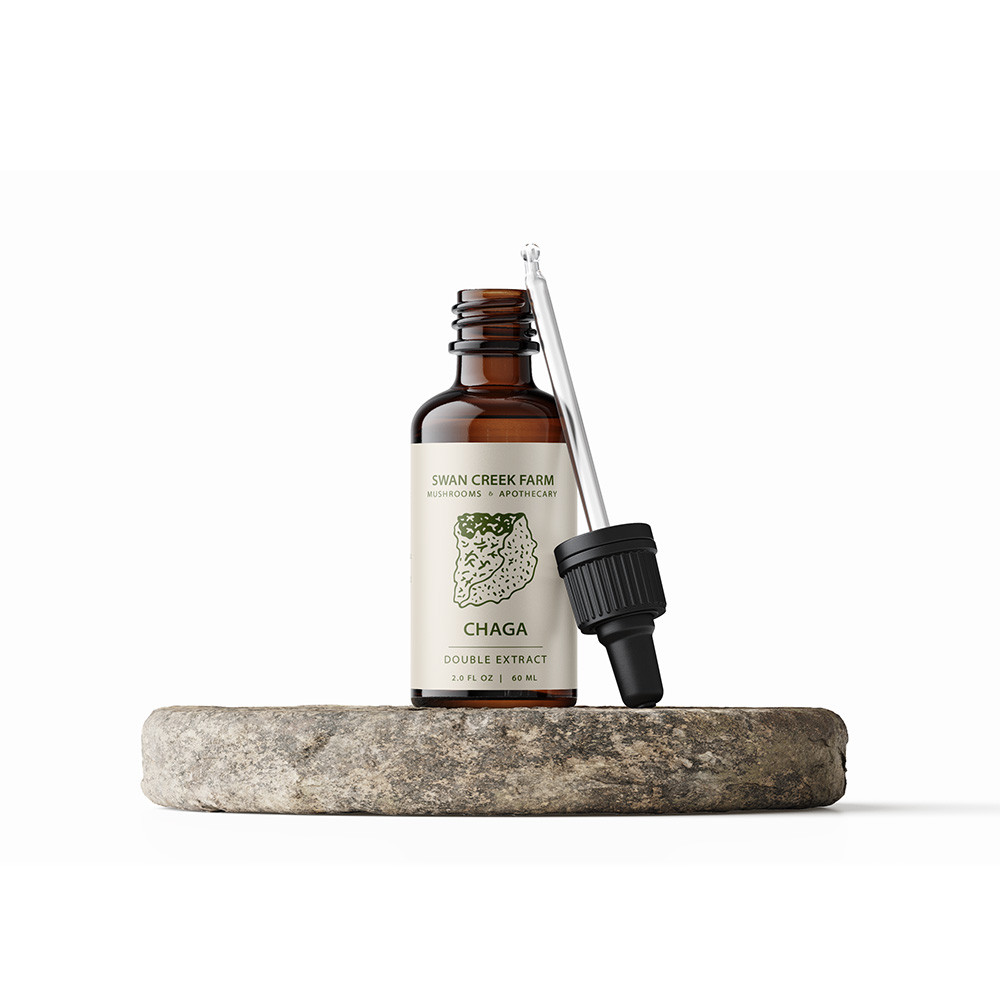

Common Name: Chaga
Pinyin Name: Bai Hua Rong
Botanical Name: Inonotus obliquus
Part Used: Sclerotium (the hard, charcoal-like conk that forms on the birch trunk)
Properties: Sweet, slightly bitter, neutral to warm
Channels Entered: Heart, Liver, Spleen, Kidney, Stomach
Chinese Medicine Primary Actions of Chaga:
- Tonifies Qi and calms the Shen (mind-spirit)
- Nourishes the Liver, Heart, Spleen, and Kidney
- Clears heat and toxins while protecting healthy tissue
- Strengthens Wei Qi, the body's protective immune energy
- Supports digestion and healthy blood sugar balance
Chinese Medicine Patterns of Imbalance Addressed with Chaga
Heart
Chaga is traditionally used to calm the Heart Shen, the aspect of the Heart system that houses the mind and governs emotional and creative expression. Regular use is associated with a steadier mood and greater mental clarity, reflecting its role in harmonizing the spirit.
Liver
Chaga nourishes Liver blood and provides potent antioxidant protection at the cellular level, helping to buffer the oxidative stress that underlies Liver Qi Stagnation and its associated irritability and fatigue.
Spleen
As a Qi tonic, Chaga supports the Spleen Energetic Organ System, improving digestion, nutrient absorption, and resilience to fatigue, consistent with its long folk history as a remedy for convalescence and low vitality.
Kidney
Chaga is considered a Kidney tonic that supports the body's deep reserves, or Jing. It is used traditionally to promote longevity and graceful aging, and to steady the body's response to chronic stress.
Wei Qi
Like other functional mushrooms, Chaga strengthens the immune function of the body, helping the body maintain balanced defenses against pathogens and inflammation.
Chaga Active Chemical Constituents
Chaga's sclerotium accumulates an unusually dense concentration of bioactive compounds as it slowly draws nutrients from hardwoods, including Birch. In the wild, Chaga grows slowly; the slow growth is part of why wild Chaga is now considered vulnerable to overharvesting. The newly found popularity of Chaga and the resulting cull does not allow wild stands to regenerate.
As with other functional mushrooms, proper extraction is essential to unlock Chaga's benefits. Chaga contains both water-soluble compounds, such as polysaccharides, and alcohol-soluble compounds, such as betulinic acid and other triterpenes. Raw Chaga powder or simply steeping chunks in hot water will only access part of its chemistry. A dual-extraction method requires that the chaga is ground, tinctured in alcohol, and then the marc decocted in water. The alcohol and water extractions are then combined as a "double extract," allowing the full spectrum of Chaga's constituents in a bioavailable form.
Betulin and Betulinic Acid
Chaga concentrates betulin and betulinic acid, triterpene compounds it absorbs from the birch bark it grows on. These compounds have been studied for their antioxidant and cell-protective properties and are far more concentrated in Chaga than in birch bark itself, since the fungus metabolizes and enriches them.
Melanin Complex
The dense black exterior of Chaga is rich in melanin pigments, which contribute to its strong antioxidant capacity and are believed to help protect the fungus; By extension, the person consuming it is protected from oxidative and environmental stress.
Polysaccharides (Beta-Glucans)
Chaga's beta-glucan polysaccharides are concentrated in the sclerotium and are largely responsible for its reputation as an immune-modulating tonic, supporting balanced immune cell activity.
Triterpenoids
Beyond betulinic acid, Chaga contains a wide range of triterpenoids that researchers are studying for their roles in supporting healthy cell function and metabolic balance.
Superoxide Dismutase (SOD) and Polyphenols
Chaga is notable among medicinal mushrooms for its naturally high levels of superoxide dismutase, an antioxidant enzyme, along with polyphenols that work together to help neutralize free radicals.
Western Medicine Benefits of Chaga
Antioxidant and Anti-Aging Support
Chaga is one of the most antioxidant-dense mushrooms studied, owing to its melanin, polyphenol, and SOD content. This translates to cellular protection against everyday oxidative stress, a key contributor to aging and chronic disease.
Immune System Support
Chaga's beta-glucan polysaccharides help modulate immune system function, supporting the body's natural defenses without overstimulating them.
Blood Sugar Balance
Research on Chaga's polysaccharides suggests they may help support already-healthy blood sugar metabolism, consistent with its traditional folk use as a tonic for metabolic balance.
Cardiovascular Health
Chaga's triterpenes and antioxidant compounds are being studied for their role in supporting healthy cholesterol levels and overall cardiovascular health.
Liver Protection
Traditional and modern use both point to Chaga's role in supporting liver function, with early research suggesting hepatoprotective properties tied to its antioxidant load.
Anti-Inflammatory Support
Chaga's compounds, particularly its triterpenoids and polyphenols, are studied for their potential to help modulate chronic inflammation, an underlying factor in many long-term health conditions.
Cancer Research
Laboratory research has examined Chaga extracts, including its betulinic acid content, for their effects on cancer cell lines. This research remains preclinical.
Anti-Fatigue and Resilience
Chaga has long been used as a tonic for convalescence and low energy, and modern research on its adaptogen-like qualities supports this traditional use for reducing fatigue and supporting stress resilience.
Skin Health
Chaga's antioxidant compounds help protect skin cells from oxidative damage and are used in topical preparations to support an even, healthy-looking complexion.
Growing & Harvesting Chaga
Chaga grows wild as a parasitic sclerotium on birch trees throughout the cold boreal forests of the northern hemisphere, including Siberia, Northern Europe, Canada, and the birch forests of northeastern China. Unlike Lion's Mane, Chaga is not typically cultivated indoors, but after years of research, Dr. Browne has developed methods to grow Chaga at her mushroom microfarm. This is important because the recent popularity of Chaga has led to the decimation of wild stands, and Chaga is becoming a threatened species due to overharvesting.
Chaga Culinary Uses
Chaga is traditionally simmered into a dark, earthy tea and is also roasted and ground as a caffeine-free coffee substitute.
Contraindications: Use with caution alongside blood-thinning medications, as Chaga may have mild anticoagulant effects. Individuals with kidney concerns and those taking diabetes medications, should consult a healthcare provider before use.
References:
Tee Yon Ern P., Tang Y. Q., Fung S. Y., Chia A. Y. Y. Therapeutic properties of Inonotus obliquus (Chaga mushroom): A review. Journal of Fungi/Mycology (Taylor & Francis). 2023. doi: 10.1080/21501203.2023.2260408.
Cheung S. S. C., Chong G., Elisia I., Hasman D., Lee M., Chang L., Ao Z., Khelifi D., Krystal G., Tai J. Wild Chaga (Inonotus obliquus) modulates inflammation, neural cell survival and inhibits proliferation of cancer cells. Pharmacological Research – Modern Chinese Medicine. 2023;9:100328.
Integrative Perspective of Naturopathy and Traditional Chinese Medicine on Chaga (Inonotus obliquus) in Healthspan. ResearchGate. 2025.
Herbal Reality. Chaga (Inonotus obliquus): Benefits, Safety, Uses.
This information has not been evaluated by the Food and Drug Administration. This information is not intended to diagnose, treat, cure, or prevent any disease.