
Reishi
Purchase Organic Lingzhi Grown in the USA Here!
Known for millennia as the "Mushroom of Immortality," Lingzhi has held the most exalted place in Chinese herbalism of any tonic substance, plant or fungus alike. It was first recorded in the Shen Nong Ben Cao Jing, the oldest materia medica in Chinese medicine, where it was ranked as a superior herb; one that could be taken daily over a lifetime to build vitality without any toxicity. Because wild Lingzhi was so rare, growing only on select decaying hardwoods, it was historically reserved for emperors and nobility, who prized it as a symbol of health, prosperity, and spiritual attainment.
Taoist tradition holds Lingzhi in the same reverence as ginseng, regarding it as an elixir capable of nourishing the spirit and lengthening life. Its Chinese name is built from two characters that together mean "spirit" or "divine essence" and "mushroom," reflecting its long-standing role in calming and elevating the Shen, or spirit, in Chinese medical theory. Ancient artisans carved its likeness into furniture, jade, and ceremonial objects as a good luck emblem, and it remains a common motif in Chinese art to this day.

Common Name: Lingzhi, Reishi
Pinyin Name: Ling Zhi
Botanical Name: Ganoderma lucidum
Part Used: Fruiting body, spores, mycelium
Properties: Sweet, slightly bitter, neutral
Channels Entered: Heart, Liver, Lungs, Kidney, Spleen
Chinese Medicine Primary Actions of Lingzhi:
- Calms the Shen (spirit) and anchors the mind
- Tonifies Qi and nourishes Blood
- Supports healthy digestion
- Benefits the five Yin organs: Heart, Liver, Lungs, Kidney, and Spleen
Chinese Medicine Patterns of Imbalance Addressed with Lingzhi
Heart
Lingzhi is classified in Chinese medicine as a substance that calms the Shen, the aspect of the Heart's energetic organ system that governs consciousness and emotional steadiness. Regular use is traditionally associated with deeper, more restful sleep, fewer heart palpitations, and a settled, less anxious state of mind.
Liver
By smoothing the flow of Qi, Lingzhi helps normalize the stress response and is traditionally used to ease irritability, tension, and low mood, all common expressions of Liver Qi Stagnation.
Lung
Lingzhi has long been used to support healthy lung function, traditionally easing chronic cough, wheezing, and shortness of breath by transforming phlegm and strengthening Lung Qi.
Kidney
As a Qi and Jing (essence) tonic, Lingzhi supports the Kidney's foundational energy, helping to counter the fatigue, low back weakness, and diminished vitality associated with age-related Kidney depletion.
Wei Qi
Like other functional mushrooms, Lingzhi strengthens the Wei Qi, or defensive immune function of the body, helping the body resist and recover from illness.
Lingzhi Active Chemical Constituents
Lingzhi is one of the most chemically complex medicinal mushrooms, containing several hundred identified bioactive compounds distributed across its fruiting body, spores, and mycelium. Its two signature compound families, triterpenes and polysaccharides, are concentrated differently throughout the mushroom, which is why full-spectrum extracts that draw from more than one part of the fungus are considered most representative of its traditional use.
As with other medicinal mushrooms, Lingzhi's cell walls are built from chitin, a tough fiber that the human digestive system cannot easily break down on its own. Without proper extraction, most of the mushroom's valuable compounds stay locked inside the cell wall and pass through the body largely unused. This is why simply swallowing capsules of raw, powdered Lingzhi delivers only a fraction of its traditional benefit.
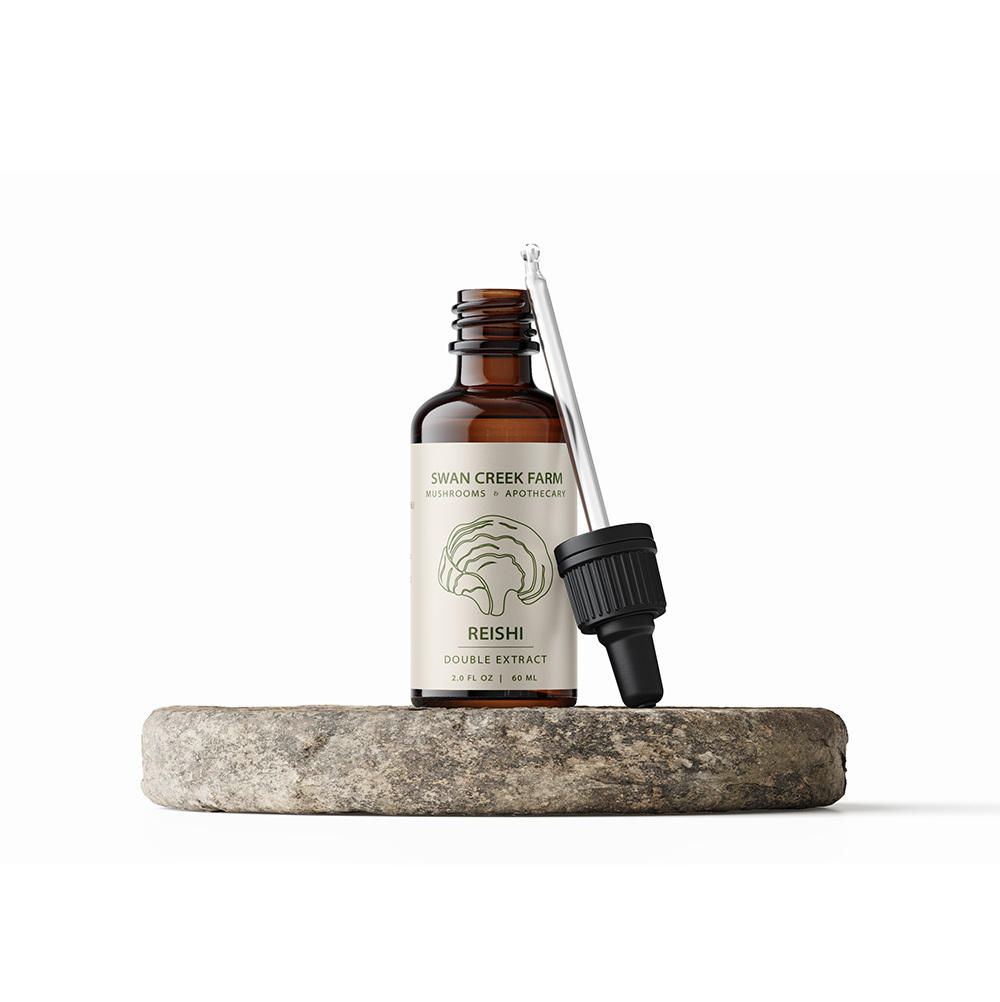
Because Lingzhi's triterpenes are alcohol-soluble while its polysaccharides are water-soluble, a single extraction method can only ever capture half of the mushroom's chemistry. A double extraction—first steeping the mushroom in alcohol, then simmering the spent material in water—draws out both groups of compounds and recombines them into one elixir, making it the most complete and bioavailable way to take Lingzhi.
Buy Lingzhi Double Extract Grown Organically in the USA Here!
Triterpenes
Lingzhi's bitterness comes largely from its triterpenes, a family that includes more than a hundred distinct ganoderic acids along with related lucidenic acids and ganoderiols. These compounds are concentrated mainly in the fruiting body and spores and are best drawn out through alcohol extraction.
Polysaccharides
Lingzhi contains over two hundred different polysaccharides, most notably beta-glucans, which are drawn out through water decoction. These large sugar molecules are central to Lingzhi's traditional reputation as a Qi tonic and immune supporter, and are found throughout the fruiting body, mycelium, and spores.
Peptidoglycans and Proteins
Lingzhi contains protein-bound polysaccharide complexes, sometimes called ganoderans, which combine amino acids with sugar chains. These compounds contribute to the mushroom's broad-spectrum tonic actions and are part of why traditional preparations value the whole mushroom rather than any single isolated fraction.
Sterols and Nucleotides
Sterols, along with adenosine and other nucleotides found in Lingzhi, contribute to its traditional use for calming the spirit and supporting restful sleep. These smaller molecules complement the triterpenes and polysaccharides, rounding out the mushroom's complex chemical profile.
Trace Minerals
Lingzhi accumulates organic germanium along with trace amounts of other minerals from the wood it grows on. While research into these trace elements is still developing, they are thought to play a supporting role in the mushroom's overall vitality-building reputation.
Western Medicine Benefits
Immune System Modulator
Lingzhi's beta-glucan polysaccharides interact with receptors on immune cells, helping to activate macrophages, natural killer cells, and T-lymphocytes. This dual, adaptogen-like action allows Lingzhi to support a sluggish immune response while also helping calm an overactive one, which is part of why it has traditionally been used for such a wide range of conditions.
Supports Healthy Stress Response and Sleep
Lingzhi has calming, adaptogen-like properties that may help ease anxiety and support more restful sleep. Its traditional use for a restless spirit is echoed in modern research suggesting it may influence neurotransmitter activity involved in relaxation.
Cardiovascular Support
Lingzhi contains triterpenes and polysaccharides that may help support healthy cholesterol and blood pressure levels already within a normal range, contributing to its long history of use for overall heart health.
Healthy Blood Sugar Metabolism
Research on Lingzhi polysaccharides suggests they may help support already-healthy insulin sensitivity and glucose metabolism, aligning with its traditional use as a whole-body tonic for those with metabolic imbalances.
Liver Support
Lingzhi has a long history of traditional use for supporting liver health, with modern research pointing to antioxidant and hepatoprotective properties in its triterpene compounds.
Cellular Health and Healthy Aging
Ganoderic acids and Lingzhi polysaccharides have been studied for their antioxidant properties and their potential to support healthy cell function, which lines up with Lingzhi's traditional reputation as a longevity tonic.
Respiratory Support
Consistent with its traditional use for chronic cough and wheezing, Lingzhi is used today to help support healthy lung function and ease occasional respiratory discomfort.
Athletic Recovery and Fatigue
Lingzhi is used to help the body adapt to physical and mental stress, supporting reduced fatigue and helping maintain stamina during demanding periods.
Skin Health
Lingzhi's antioxidant compounds may help protect skin cells from oxidative stress, supporting an even, healthy-looking complexion over time.
Growing & Harvesting Lingzhi
Lingzhi is cultivated on hardwood logs or enriched sawdust substrates, most often oak, and takes considerably longer to mature than many other functional mushrooms, developing its signature lacquered, reddish-brown cap over several months. You can purchase a fruiting block of Lingzhi here and grow your own.
Lingzhi Culinary Uses
Unlike many functional mushrooms, Lingzhi is too woody and bitter to eat as a food. It is traditionally sliced and simmered into teas, soups, and decoctions, or taken as a powder or extract, rather than cooked and eaten whole.
Contra-indications: None known; those on blood-thinning or blood pressure medication should consult a healthcare practitioner before use.
References:
Bishop K.S., Kao C.H., Xu Y., Glucina M.P., Paterson R.R., Ferguson L.R. From 2000 years of Ganoderma lucidum to recent developments in nutraceuticals. Phytochemistry. 2015;114:56-65. doi: 10.1016/j.phytochem.2015.02.015.
Cör D., Knez Ž., Knez Hrnčič M. Antitumour, antimicrobial, antioxidant and antiacetylcholinesterase effect of Ganoderma lucidum terpenoids and polysaccharides. Molecules. 2018;23(3):649. doi: 10.3390/molecules23030649.
Jin X., Ruiz Beguerie J., Sze D.M., Chan G.C. Ganoderma lucidum (Reishi mushroom) for cancer treatment. Cochrane Database Syst Rev. 2016;(4):CD007731. doi: 10.1002/14651858.CD007731.pub3.
Liu J., Feng L., Gu J., et al. Oral administration of Ganoderma lucidum polysaccharide can generate long-lasting immunity. Int. J. Biol. Macromol. 2020;158:1130-1139.
Wachtel-Galor S., Yuen J., Buswell J.A., Benzie I.F.F. Ganoderma lucidum (Lingzhi or Reishi): a medicinal mushroom. Herbal Medicine: Biomolecular and Clinical Aspects, 2nd edition. CRC Press/Taylor & Francis; 2011. Chapter 9.
Wang J., Cao B., Zhao H., Feng J. Emerging roles of Ganoderma lucidum in anti-aging. Aging Dis. 2017;8(6):691-707. doi: 10.14336/AD.2017.0410.
Xie J.T., Wang C.Z., Wicks S., et al. Ganoderma lucidum extract inhibits proliferation of SW 480 human colorectal cancer cells. Exp Oncol. 2012;28(1):25-29.
Zeng P., Guo Z., Zeng X., et al. Chemical, biochemical, preclinical and clinical studies of Ganoderma lucidum polysaccharide as an approved drug for treating myopathy and other diseases in China. J Cell Mol Med. 2018;22(7):3278-3297. doi: 10.1111/jcmm.13613.
This information has not been evaluated by the Food and Drug Administration. This information is not intended to diagnose, treat, cure, or prevent any disease.