
Maitake
Historically referred to as "Hui Shu Hua" or grey tree flower, Maitake has been valued in Asian culture as both a food and a traditional Chinese medicine for thousands of years. In Japan, this mushroom's name literally translates to "dancing mushroom," a reference to the joy foragers felt upon finding it, since in earlier times it could be traded for its weight in silver. It grows in overlapping, frond-like clusters at the base of oak and other hardwood trees, giving it a rippling appearance that resembles a cluster of dancing butterflies.
Maitake is also known in the West as hen-of-the-woods, ram's head, or king of mushrooms, a nod to the high esteem in which it has long been held in Japanese and Chinese herbal traditions. Unlike some functional mushrooms that were reserved for royalty or monastics, Maitake was widely eaten as a food and used as an everyday tonic to help the body return to balance.
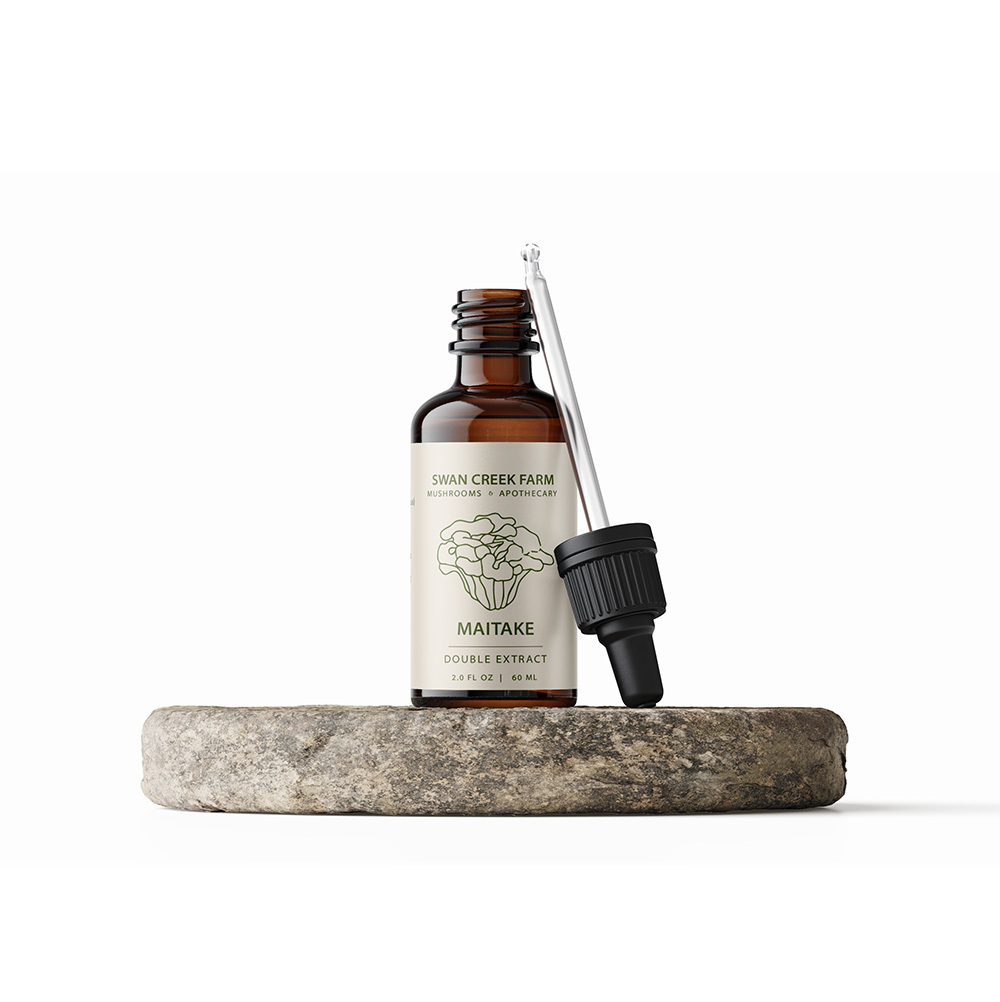

Common Name: Maitake
Pinyin Name: Hui Shu Hua
Botanical Name: Grifola frondosa
Part Used: Whole fungi, fruiting body, mycelium
Properties: Sweet, neutral
Channels Entered: Spleen, Stomach, Liver, Kidney
Chinese Medicine Primary Actions of Maitake:
- Tonifies Spleen and Stomach Qi
- Calms the Shen (spirit) and eases anxiety
- Supports healthy digestion
- Harmonizes metabolism and helps the body adapt to stress
- Benefits the Spleen, Stomach, Liver, and Kidney organ systems
Chinese Medicine Patterns of Imbalance Addressed with Maitake
Spleen and Stomach
Maitake is prized above all as a Spleen Qi tonic that strengthens the "center," supporting the Spleen and its paired organ, the Stomach, in transforming food into usable Qi. This is reflected in improved digestion, steadier energy after meals, and better nutrient absorption with regular use.
Liver
As an adaptogen, Maitake helps the body normalize its response to stress. By calming the Shen and easing the restlessness associated with what Western medicine would call anxiety, Maitake indirectly supports smooth Liver Qi flow and helps prevent Liver Qi Stagnation.
Kidney
Maitake is traditionally used for patterns involving cold and excess Yin, gently warming the body's metabolism. This makes it a useful ally for individuals who run cold or whose Kidney energy needs steady, long-term support rather than aggressive tonification.
Wei Qi
Like other functional mushrooms, Maitake benefits the immune function of the body, helping to build resistance and defend against invasion by external pathogens.
Maitake Active Chemical Constituents
Bioactive compounds extracted from the fruiting bodies and mycelia of Maitake mushrooms have been the subject of extensive research, particularly for their effects on immune cell activity. As with other functional mushrooms, both the fruiting body and mycelium contain different profiles of active compounds, so products that utilize both forms help capture the full range of benefits Maitake has to offer.
To ensure that beneficial compounds from mushrooms are bioavailable and can be absorbed by the human body, proper extraction is essential. Raw mushrooms contain chitin, a fibrous polysaccharide that forms the cell walls of fungi. While chitin is a good source of dietary fiber, it also hinders the absorption of the beneficial compounds found in functional mushrooms unless they are extracted correctly. Consequently, taking capsules filled with dried Maitake mushroom powder will not provide the same health benefits as a proper Maitake extract. In fact, raw mushroom powder offers minimal benefit, yet Maitake powdered capsules are commonly sold online.
It is also vital to know that alcohol extraction renders different chemical constituents than water extraction, and Maitake for use as a wellness remedy is best consumed as a double extract using a 2-step method. In the first step, the mushroom is steeped in high concentrations of alcohol for six weeks, then strained. The marc, or leftover mushroom, is then boiled in water and strained. The alcohol extract and water decoction are then combined for a Maitake elixir containing the full spectrum of constituents in a bioavailable form.
Beta-Glucans (D-Fraction and MD-Fraction)
Maitake is best known for its beta-glucan polysaccharides, particularly the D-Fraction and the more purified MD-Fraction, which are branched (1,6)-beta and (1,3)-beta-D-glucans isolated from the fruiting body. These compounds have been studied for their ability to activate macrophages, natural killer (NK) cells, and dendritic cells, supporting the body's own immune surveillance.
Grifolan and MZ-Fraction
Grifolan is a beta-glucan first isolated from Maitake mycelium, while the MZ-Fraction is a lower molecular weight beta-glucan with both (1,3) and (1,6) linkages. Both have been studied for their ability to enhance cytokine production, including TNF-alpha and IL-12, contributing to Maitake's reputation as an immune-supportive mushroom.
Alpha-Glucans
In addition to its beta-glucans, Maitake contains alpha-glucans that have been studied for their role in supporting healthy blood sugar metabolism, complementing the mushroom's traditional use for supporting the Spleen and Stomach.
Ergosterol
Ergosterol is a sterol compound and precursor to vitamin D found in Maitake. It contributes antioxidant activity and has been studied for its role in supporting healthy cell growth.
Trehalose and Amino Acids
Maitake's distinctive sweet, umami flavor comes largely from trehalose along with glutamic and aspartic amino acids. Trehalose is a slow-digesting sugar that has also been studied for its ability to support the growth of beneficial gut bacteria such as Bifidobacterium and Lactobacillus species.
Novel Compounds
Research into Maitake's numerous benefits is ongoing, with novel compounds such as lysophosphatidylethanolamine identified as having neurotrophic activity, and grifolic acid and various lectins and metalloproteins under continued investigation. These compounds contribute to our understanding of Maitake's wide-ranging effects on metabolism and immunity, but demonstrate that we have much left to learn.
Western Medicine Benefits
Immune System Support
Maitake's beta-glucans, particularly the D-Fraction and MD-Fraction, have been shown to activate macrophages, NK cells, and T-cells, supporting the body's natural defenses against pathogens and abnormal cell growth. This immune-modulating activity is among the most well-researched effects of any functional mushroom.
Supports Cancer Care
Maitake extract has been studied as a complementary approach alongside conventional cancer treatments. Clinical and laboratory research suggests that Maitake's D-Fraction and MD-Fraction may help enhance the effect of chemotherapy, support recovery of white blood cells, and reduce some of the immunosuppressive effects of cancer treatment, although it is not recommended as a stand-alone treatment.
Healthy Blood Sugar Metabolism
Maitake has been studied for its alpha-glucan content and its potential to support healthy insulin sensitivity and glucose metabolism, making it a mushroom of interest for those managing blood sugar concerns.
Cardiovascular Support
Maitake has been studied for its ability to help maintain healthy cholesterol and blood pressure levels already within a normal range, contributing to overall cardiovascular wellness.
Weight Management
Maitake has traditionally been used to support healthy metabolism, and modern research has explored its potential role in supporting healthy body weight when combined with a balanced diet.
Hormonal Balance
Maitake extract has been studied for its potential to support ovulation and hormonal balance in women, including research into its use alongside first-line fertility treatments.
Calms the Mind
As an adaptogen, Maitake has traditionally been used to calm the Shen, helping ease the restlessness and worry associated with what Western medicine describes as anxiety and chronic stress.
Antiviral Support
Maitake has been studied for antiviral activity and has been explored as a complementary support in immune conditions, including early research into its use alongside conventional HIV therapies.
Growing & Harvesting Maitake
Maitake grows in the wild at the base of oak and other hardwood trees, forming large, dense clusters that can weigh up to 45 kg (100 lbs) in a single bunch. It is cultivated both outdoors on hardwood logs and indoors on hardwood sawdust substrates, and is enjoyed fresh as a culinary mushroom in addition to its use in wellness preparations.
Maitake Culinary Uses
Maitake has a strong, earthy flavor and firm texture, making it a popular addition to broths, soups, and sautéed vegetable dishes. It is widely enjoyed as a nutritious food in Japanese and Chinese cuisine in addition to its long history of use as a medicinal mushroom.
Contra-indications: None known. As with other functional mushrooms, those on immunosuppressant medications should consult a healthcare practitioner before use.
References:
Chen J.T., Tominaga K., Sato Y., et al. Maitake mushroom (Grifola frondosa) extract induces ovulation in patients with polycystic ovary syndrome: A possible monotherapy and a combination therapy after failure with first-line clomiphene citrate. Journal of Alternative and Complementary Medicine. 2010;16(12):1295–1299. doi: 10.1089/acm.2009.0696.
Deng G., Lin H., Seidman A., et al. A phase I/II trial of a polysaccharide extract from Grifola frondosa (Maitake mushroom) in breast cancer patients: immunological effects. Journal of Cancer Research and Clinical Oncology. 2009;135(9):1215–1221. doi: 10.1007/s00432-009-0562-z.
Kodama N., Komuta K., Nanba H. Can maitake MD-fraction aid cancer patients? Alternative Medicine Review. 2002;7(3):236–239.
Kubo K., Aoki H., Nanba H. Anti-diabetic activity present in the fruit body of Grifola frondosa (Maitake). Biological & Pharmaceutical Bulletin. 1994;17(8):1106–1110. doi: 10.1248/bpb.17.1106.
Lin H., de Stanchina E., Zhou X.K., et al. Maitake beta-glucan promotes recovery of leukocytes and myeloid cell function in peripheral blood from paclitaxel hematotoxicity. Cancer Immunology, Immunotherapy. 2010;59(6):885–897. doi: 10.1007/s00262-009-0813-8.
Masuda Y., Inoue H., Ohta H., Miyake A., Konishi M., Nanba H. Oral administration of soluble beta-glucans extracted from Grifola frondosa induces systemic antitumor immune response and decreases immunosuppression in tumor-bearing mice. International Journal of Cancer. 2013;133(1):108–119. doi: 10.1002/ijc.27999.
Nanba H. Maitake D-fraction: healing and preventing potentials for cancer. Townsend Letter for Doctors and Patients. 1996:84–85.
Nishina A., Kimura H., Sekiguchi A., Fukumoto R.H., Nakajima S., Furukawa S. Lysophosphatidylethanolamine in Grifola frondosa as a neurotrophic activator via activation of MAPK. Journal of Lipid Research. 2006;47(7):1434–1443. doi: 10.1194/jlr.M600045-JLR200.
Wu J.-Y., Siu K.-C., Geng P. Bioactive ingredients and medicinal values of Grifola frondosa (Maitake). Foods. 2021;10(1):95. doi: 10.3390/foods10010095.
This information has not been evaluated by the Food and Drug Administration. This information is not intended to diagnose, treat, cure, or prevent any disease.